How does my 9-1-1 call get to the right person?
I have been asked many times how a 9–1–1 call gets to the right person. And as a follow up, “How does 9–1–1 know where I am?”. The answer is usually much trickier than a simple post, but I hope I can cover most cases for someone with curiosity and a healthy interest in how 9–1–1 works.
This primer is based on NENA’s Next Generation 9–1–1 standardization efforts in North America and not any specific implementations. Other locations may have common elements and many differences. NENA (National Emergency Number Association) is the body behind the standardization of 9–1–1.
I dialed 9, 1, and 1. Now what?
This might very well be the most terrifying call a person will ever make. Behind these three digits, many first responders (police, fire, EMS, dispatch, among others) and hundreds of professionals (network, software, ops, and other engineers) work to bring you help as reliably, quickly, and accurately as possible.
From the moment you dial 9–1–1, a chain of events happens in a very short amount of time. Every step is designed to be fault-tolerant and redundant. While this is a condensed version of what happens in a call, it should give you a good idea of the steps involved.
First things first
Your call arrives at your carrier’s network as any other call would. Up to here, everything is quite normal. At this point, your carrier will have a connection to your area’s ESInet (Emergency Services IP Network). By region, this can be your state, it can be a group of states, a group of counties, or your country (as is the case in several countries in Europe).
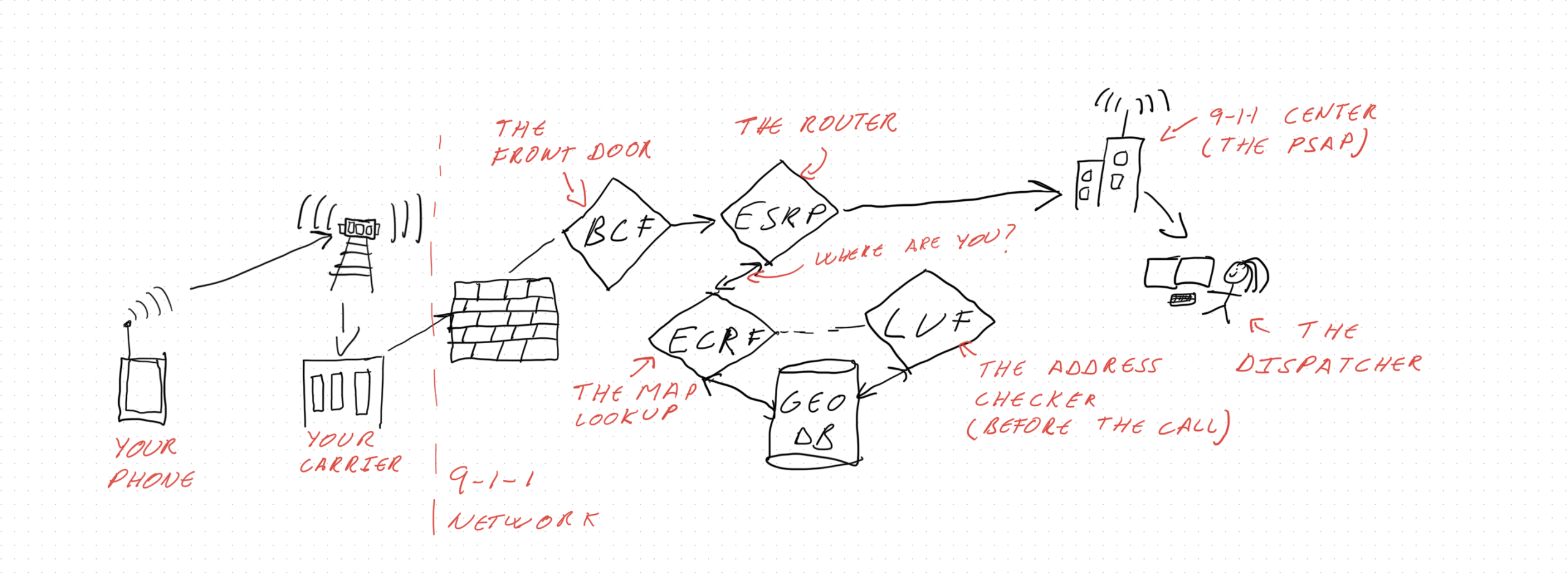
Once your carrier delivers the call to the ESInet, this is where the fun begins. The diagram above traces the whole path.
Finding your way
At the entrypoint of the ESInet the call will already be or become a SIP call (think of it as fully digital) if it had to be converted from old phone systems. Carriers are working on making sure all calls already arrive as SIP with all the metadata necessary attached to it.
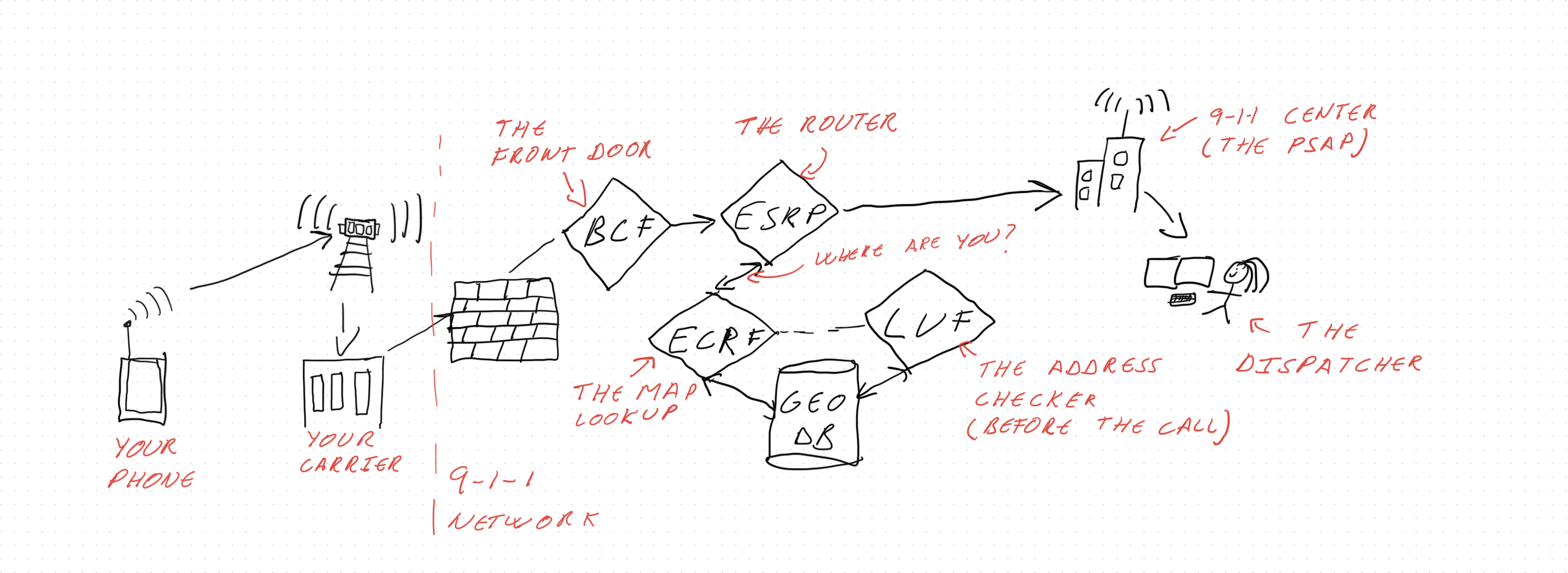
The BCF (Border Control Function) will make sure this call is in good healthy condition and contains all the necessary information to be handled by all of the elements. Once this happens, the call will move on to the ESRP.
The ESRP (Emergency Services Routing Proxy) is, as its name indicates, a routing component. But it is more complex than a simple table. As I previously indicated, the SIP call contains some metadata, including a piece that contains geographic information. This is arguably one of the most important elements of the call. The contents of this field can be an actual address, a geodetic point (or shape), or a simple URL pointing to where the data might be. Or all of the above!
The carrier can determine the location of the call in several ways, and they have improved over time. The oldest is simply reporting the tower the caller is connected to (that’s Phase I), and a tower’s coverage can span several miles. Phase II raised the bar to an actual coordinate, latitude and longitude (and over time, elevation), historically produced by triangulating against several towers. Modern device-based location is more precise again, using the handset’s own GNSS alongside nearby Wi-Fi networks. The FCC mandates a minimum accuracy and reliability of this location.
The ESRP extracts this piece of data and sends it to the ECRF with a very specific question: “Who can answer this emergency call in this specific geographical point?”
The ECRF (Emergency Call Routing Function) will take this (LoST) query and check its internal GIS data, place the point (or polygon) in the map and extract a URI that matches the location of the call with the service that covers the area where the call was made from. The ECRF will send back this URI to the ESRP.
The ESRP will take this URI and match it against an actual network destination that it knows about and forward the call to that specific address. Once the call has reached the 9–1–1 center (PSAP), it will go to an available position and this person will receive your call.
We are skipping many steps here: What if the PSAP is flooded and can’t receive any calls right now? This is contemplated and the call will go somewhere else, or what if the ECRF is down? There is design around this in the standards as well.
I just moved to a new address, will 9–1–1 know my new address?
Another complicated question, but yes. And this is where the LVF (Location Validation Function) will have a crucial role. Authorities provide the 9–1–1 providers with the GIS (geographical information, think of it as mapping) of the jurisdiction covered. Including every address. When someone moves or a carrier gets a new landline or VoIP subscriber (if they choose to register it), it has the capacity to ask the 9–1–1 provider “are you aware of this address that can now call 9–1–1?”. If so, we’re all good. If not, this question triggers a whole process to make this address available to 9–1–1.
The call you hopefully won’t have to make
While it all seems quite complex (and it is), 9–1–1 is one of the most reliable systems you will interact with. From the technologies to the passionate professionals around it, this is one of the best-oiled machines you will hopefully never have to interact with.
Ismael Arenzana led engineering at one of the top US NG911 providers. He writes about mission-critical systems, technology and everything in between at arenzana.org.
